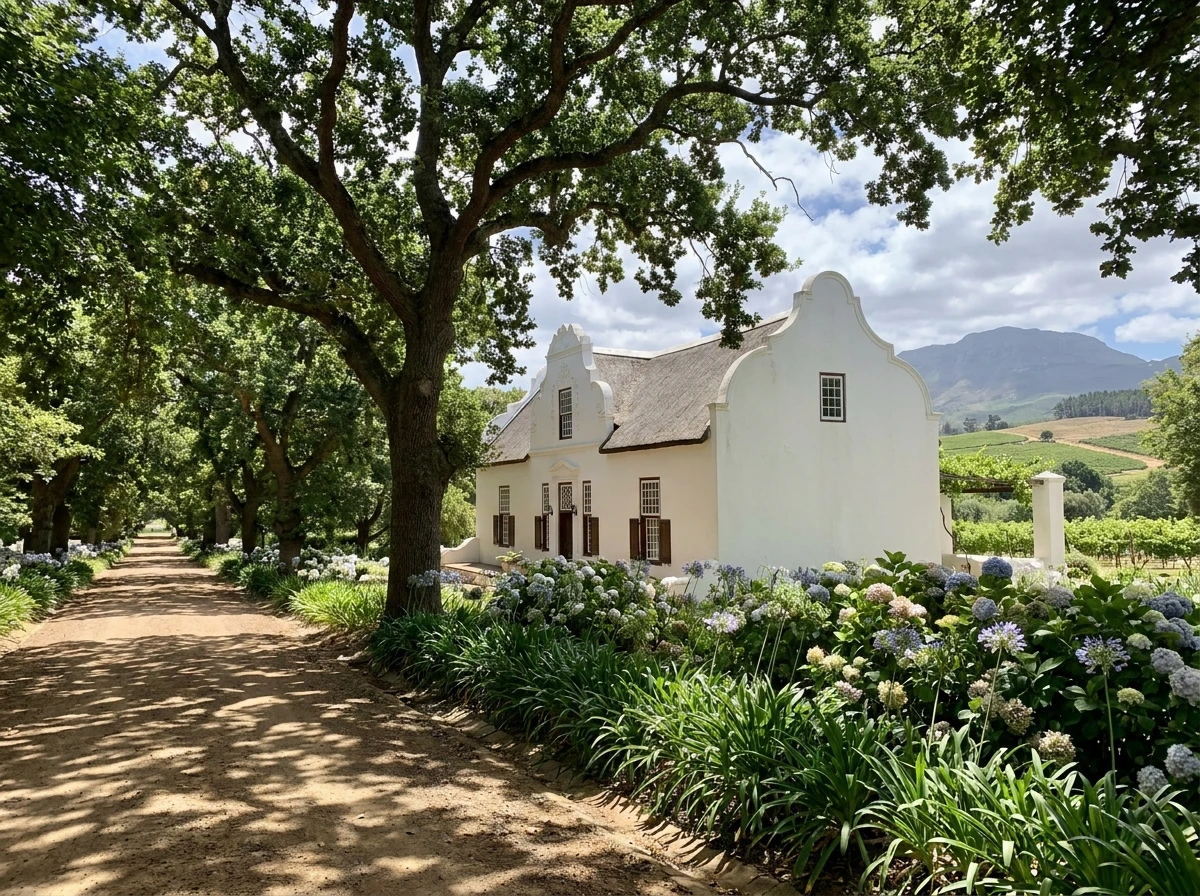
Stellenbosch sits across the mountains from Franschhoek, reached via the R310 Helshoogte Pass — a university town built around an oak-lined heritage core (Dorp Street among the best-known) of Cape Dutch, Georgian and Victorian buildings, ringed by newer wine-estate development with wide glass walls facing the vines. The same near-identical Winelands basin sun path and Mediterranean climate apply here as in Franschhoek, with Stellenbosch's own Simonsberg and Helderberg mountains shaping its particular wind pattern rather than Franschhoek's three-mountain horseshoe.
Dorp Street-class heritage homes and student-let Victorians want the same inside-mount answer as a protected Franschhoek gable: timber or aluminium venetians on the original sash stock, no facade change needed, cellular blinds for genuine winter insulation on an older solid-walled room. The wine-estate ring around town takes wide new glass well — motorised roller blinds, concealed ceiling-recess systems and external venetians on a west-facing tasting room or entertaining wall.
One free in-home measure covers the whole brief, whether it's a single heritage sash window on Dorp Street or a full wine-estate glass wall on the town's edge.
Anyone specifying for a house inside the old oak-lined streets has to reckon with the trees before the windows. In full leaf they are a genuine shading layer: a ground-floor room on Dorp Street in February can be comfortable at four in the afternoon purely because of what is overhead. By July the same room, with the canopy bare, takes low northern sun straight through the glass for most of the day. Specify for the day you happen to visit and you get it wrong in one season or the other, so at the measure we ask what a room does in winter as well as what it is doing while we stand in it.
The old building stock helps and hinders in equal measure. Thick walls and deep-set sashes give a real reveal to work in, which is why an inside mount usually looks right here and needs nothing fixed to the frontage. The same walls hold their temperature well, so a room that gets properly cold in a Boland July stays cold; that is where a cellular blind earns its place, because the trapped air in the cells slows heat loss through a single-glazed pane in a way no flat fabric does.
The estate ring on the town’s edge is a different brief entirely. New glass, wide sliding runs, west-facing entertaining rooms that look toward the mountains and take the full weight of the late afternoon. That is where shading outside the pane makes the difference, because an interior blind is always working on heat that has already arrived. It is also where motorisation stops being a luxury: a run of linked blinds on one control gets used, and a wall of individual chains does not.
Two honest limits. In the heritage core, whether anything at all may be fixed to a street-facing facade is not our call to make — it is a matter for the property’s own heritage position and the relevant authority, and we will not quote an exterior system on that elevation as though the permission were a formality. We would rather put an interior answer in the quote and let you pursue the outside option separately if you want it. And on a house let to students, we would steer away from delicate hardware toward something that survives being operated by people who did not choose it: a spring or wand mechanism rather than a fine chain, and a fabric that wipes clean. The free measure covers a single sash or a whole estate house on the same terms, and every window is priced on its own line.
Ready when you are
Send the form and one of our expert consultants will contact you shortly to arrange your free in-home measure.
Request my call-back →